The short version
- Start with five core pages: home, services, about, reviews or past work, and contact.
- Add a page for each service you want customers to find you for. In 2026, local search experts ranked this the most important thing for showing up in normal local Google results.
- Add a page for each town you want work from, but only if you can write something true and useful about working there.
- Google doesn't reward a site for being big. Every page needs a reason to exist, and pages made only to rank can count against you.
Most "how many pages" advice online says five to ten. That's fine for a business that people find by name, through word of mouth or social media. If you want new customers to find you on Google when they search for the job you do, five to ten pages usually isn't enough, and the rest of this guide explains why.
Why the number of pages matters at all
When someone needs a local business, they search for the job and the place, like "boiler service Leighton Buzzard" or "puncture repair Aylesbury". Google then looks for the page on the web that best matches that search.
A homepage that lists ten services and fifteen towns is a weak match for every one of those searches. A page all about boiler servicing, or all about working in Leighton Buzzard, is a strong match for that one search. More of the right pages means more searches you can show up for.
In Whitespark's 2026 survey of 47 local search specialists, "Dedicated Page for Each Service" came out as the number one factor for ranking in normal local results, with town and area relevance second and linking between your own pages sixth (Whitespark, 2026).
The number itself isn't the goal, though. Google's John Mueller has said "it's certainly not the case that just having more pages indexed is a sign of quality" (Search Engine Journal). The aim is a page for each search your customers make, and nothing extra.
The five pages every business needs
Whatever you do, these are the pages people expect to find. They're also the ones most likely to be visited by someone who already knows your name and wants to check you out.
| Page | What it's for |
|---|---|
| Homepage | What you do, where, and how to get in touch, all visible without scrolling. Links out to every service. |
| Services | A short overview of everything you do, linking to each service's own page. |
| About | Who's behind the business, how long you've been doing it and photos of you. |
| Reviews or past work | Real reviews with names, and photos of jobs you've done. |
| Contact | Your number, a short form, your hours and the area you cover. |
You'll also need a privacy notice if your website has a contact form or collects anyone's details. The ICO says "every organisation that holds people's information needs to explain why it holds it and what it does with it" (ICO), and it has a free tool to help you write one. Limited companies also have to show their registered name, company number and registered office address on their website (legislation.gov.uk). The footer is a fine place for those.
A page for each service you offer
This is where most small business websites fall short. If every service sits in one list on the homepage, Google has very little to show for a search like "lip filler Leighton Buzzard" or "cambelt replacement Milton Keynes".
DA Aesthetics, a nurse-led clinic in Wing, had all nine treatments as a ticked list on one homepage. Each treatment now has its own page covering what it is, what recovery is like, what results to expect and the questions people ask before booking.
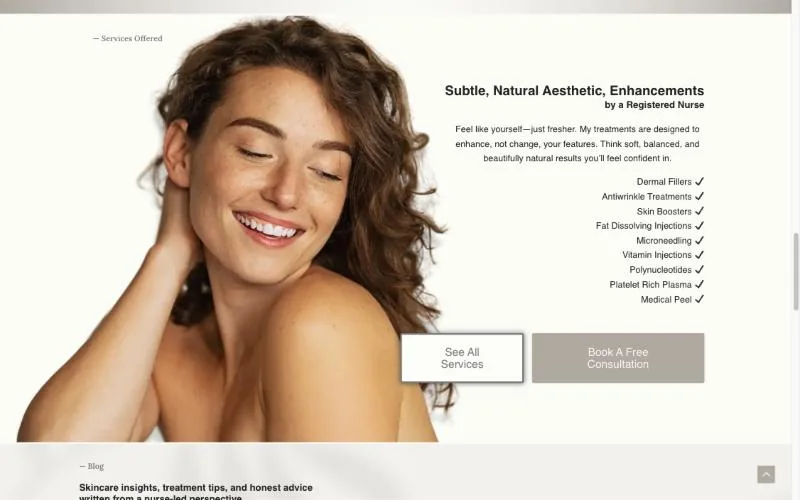
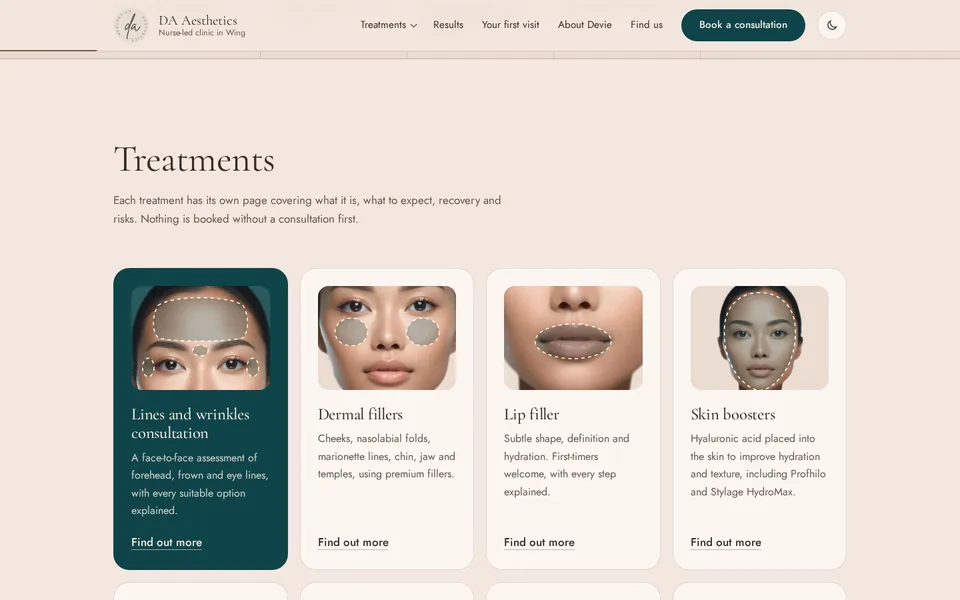
Give a service its own page when people search for it by name, you want more of that work, and you've got enough to say about it to fill a page that's useful to read. Questions customers ask, what's included, how long it takes and photos of that job all count.
Keep services together when they're small parts of a bigger job, or you'd struggle to write more than a paragraph about one. A painter doesn't need a separate page for "skirting boards". It can be a line on the interior decorating page.
Start with the work you want more of, then work down the list. See how DA Aesthetics went from one homepage to 23 pages.
A page for each town you want work from
If you cover more than one town, a page for each of your main ones helps Google connect you with searches there. It also tells customers in that town that you actually go there.
This is the type of page that's most often done badly. Google's spam policies list "having multiple domain names or pages targeted at specific regions or cities that funnel users to one page" as an example of doorway abuse (Google). In practice that means pages where the only difference is the town name.
I use a simple test before writing one. If you could swap the town name for another and the page would still read as true, it isn't ready. A good town page mentions things that are only true of that place: the areas you cover within it, the jobs you do most there, roads, landmarks, how far you travel and real jobs you've done nearby.
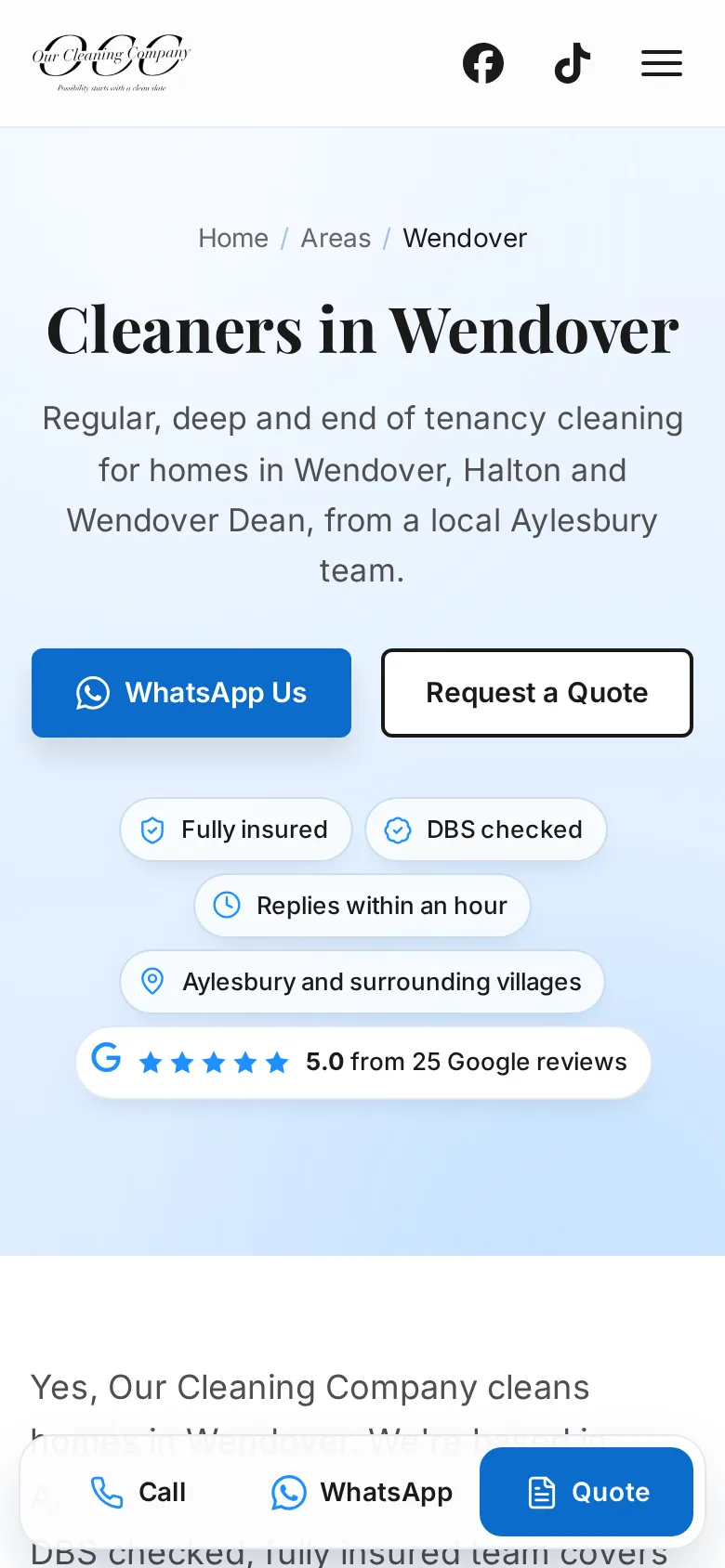
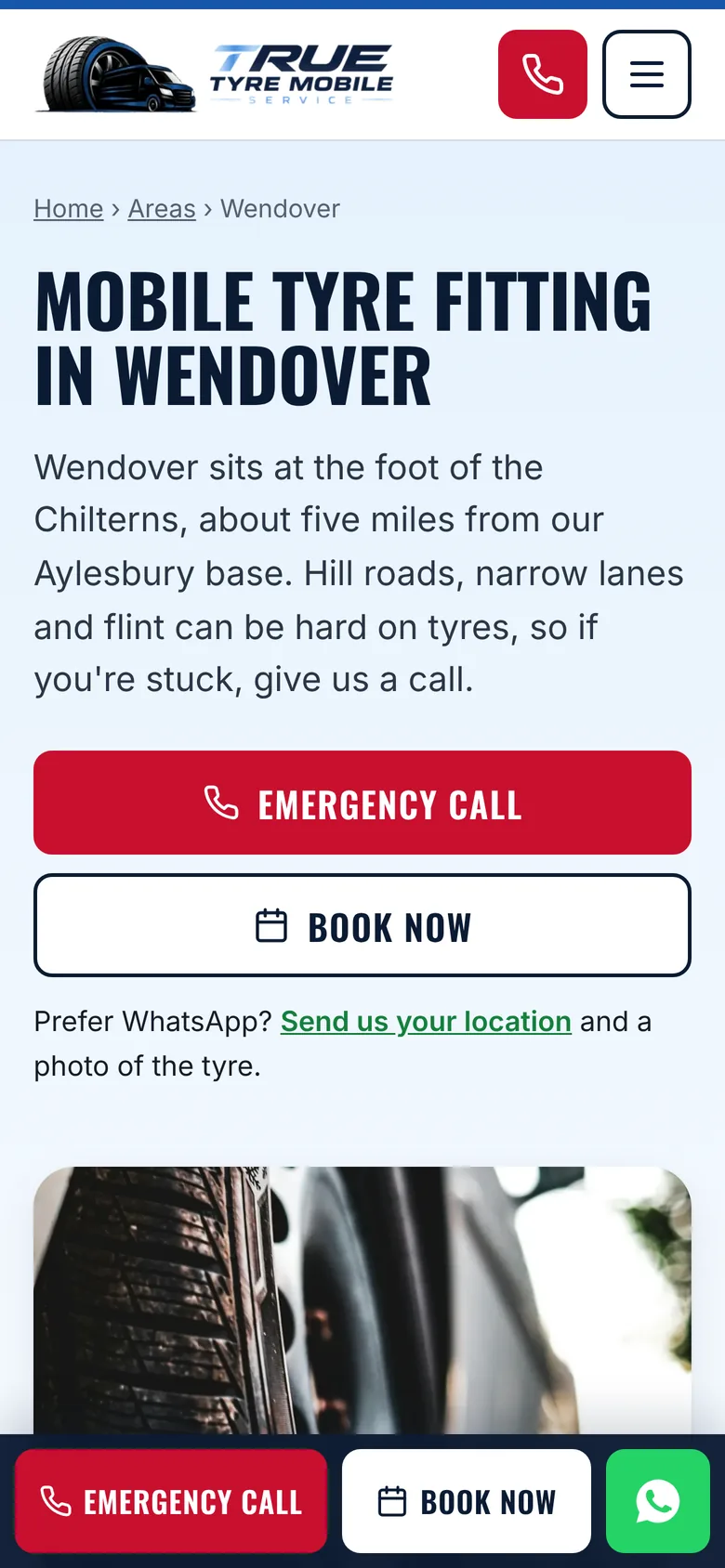
Both of those businesses cover Wendover, and their pages are completely different, because what a cleaner and a tyre fitter need to say about the town is different. Pick the towns you want more work from, and add more once you've done jobs there you can talk about.
Pages that answer questions
People search questions as well as services: "can I drive on a flat tyre?", "how do I get limescale off a shower screen?", "how long does lip filler last?". A short guide that answers one of these is another way for a customer to find you before they know who you are.
These pages matter more now that Google shows AI answers above the results. One study across 53 business accounts found AI Overviews appear on 36% of information searches, and brands quoted inside them got 120% more clicks than brands that weren't (Seer Interactive, 2026). Start each guide with a direct answer in the first sentence, because that's the part most likely to be quoted.
These pages are optional. Add one when you notice customers asking you the same question again and again, and stop if you can't keep them accurate.
Real page counts from six websites
These are local businesses I've built websites for. The numbers are different because the businesses are different, and each one follows the same pattern of core pages, service pages and town pages.
| Business | What's on the site |
|---|---|
| Crown & Texture, haircare brand | 1 page for now. The shop isn't open yet, so the site has one job: collecting early access signups. |
| Anthony Mason Upholstery, Wingfield | 20 pages, including 6 service pages and 5 town pages, from Bedford to Milton Keynes. |
| DA Aesthetics, Wing | 23 pages, including 11 treatment pages and 5 town pages. |
| MH Auto Services, Bletchley | 25 pages, including 12 service pages and 70 questions answered. |
| Our Cleaning Company, Aylesbury | 29 pages, including 10 service pages, 6 town pages and 3 guides. |
| True Tyre Mobile Service, Aylesbury | 37 pages, including 11 service pages, 9 town pages, a motorways page and 8 guides. |
The garage has more service pages than the cleaner because it does more distinct jobs. The tyre fitter has the most town pages because a mobile business travels further than a garage with a workshop. Your number should come from your business in the same way.
Work out your number
Here's the sum I use when planning a website:
| Pages | How many |
|---|---|
| Core pages | 5, plus a privacy notice |
| Service pages | One for each service people search for by name |
| Town pages | One for each main town you want work from and can write about honestly |
| Guides | Optional. One for each question customers keep asking you |
Say you're a plumber in Leighton Buzzard who does boiler servicing, boiler installs, bathroom fitting and emergency callouts, and you want work from Leighton Buzzard, Dunstable and Milton Keynes. That's 5 core pages, 4 service pages and 3 town pages: 12 pages, plus a privacy notice. If customers keep asking why their boiler pressure keeps dropping, that's your first guide.
Not every page needs to be in your main menu. Service pages can sit under a Services menu, and town pages can be linked from an areas page and your footer. What matters is that every page is linked from somewhere, so Google and your customers can find it.
When fewer pages is better
A one-page website is fine when you do one thing in one place, when you're testing an idea, or when the site has a single job. Crown & Texture's early access page is one page on purpose: it exists to collect signups before the shop opens, and extra pages would only get in the way.
Fewer pages is also better than thin ones. Google's spam policies describe "scaled content abuse" as "when many pages are generated for the primary purpose of manipulating search rankings and not helping users" (Google). Twenty near-identical town pages, or a page for every small variation of the same service, can do more harm than good.
Watch out for two pages competing for the same search too, like "Kitchen fitting" and "Kitchen installation". Merge them into one stronger page. And there's no minimum length to hit. Mueller has said the number of words on a page "is not a quality factor, not a ranking factor" (Search Engine Journal). Write enough to answer what a customer needs to know, then stop.
Checklist
- My website has a homepage, services, about, reviews or past work and contact page
- I have a privacy notice, and my company details are in the footer if I'm a limited company
- Each service I want more work for has its own page
- Each service page answers the questions customers ask me about that job
- I have a page for each main town I want work from
- Each town page would stop being true if I swapped the town name
- No two pages are trying to rank for the same search
- Every page is linked from at least one other page
- Each page has a clear way to call or get in touch
Questions people ask
Is a one-page website bad for SEO?
Not always. A one-page site can rank for your business name and one main service in one town. It struggles when you do several things or cover several places, because one page can't be the best match for all of those searches.
Do more pages mean better Google rankings?
Only if each page matches something people search for and is useful when they land on it. Google has said having more pages isn't a sign of quality on its own, and pages made only to rank can count against you.
How long should each page be?
Long enough to answer what a customer needs to know before they get in touch. Google has said word count isn't a ranking factor, so there's no target to hit.
Do I need a blog?
Not a blog in the "latest news" sense. Guides that answer the questions customers ask you are worth having, but only add them when you can keep them accurate. An abandoned blog with a post from 2019 looks worse than no blog.
Does a website with more pages cost more?
Usually, yes, because each page takes time to plan, write and build. My guide to how much a website costs explains what affects the price. You can start with your most important services and towns and add more over time.
Not sure which pages your website is missing? Send me your link and I'll tell you which ones to add first, free.
Get my free check